You've bought insoles before.
Nurses. Warehouse crews. Line cooks, stylists, teachers.
Eight to fourteen hours on concrete, tile or steel deck, in shoes somebody else picked.
Most of them have bought insoles before. Two pairs, three, five.
It usually goes the same way. The first week feels like the problem is solved. Month two is fine. Somewhere around month three the foam has packed flat and the mornings are back to what they were.
The easy explanation is that the body is wearing out.
That's where most people land, and it's why a lot of them stop buying anything at all. If the cause is age, or weight, or twenty years of standing, then there's nothing to buy. There's only something to put up with.
Here's the part that isn't printed on any box on the shelf.
Nearly every insole in that closet was built around one thing: the arch. Arch height, arch shelf, arch support. It's the claim on all of the packaging, and it isn't a lie — the arch is real and supporting it does real work.
But the sharpest heel pain in this line of work doesn't start at the arch.
It starts about an inch behind it, underneath the heel bone, where the body keeps a shock absorber of its own: a dense pad of fat built specifically to take impact, and better at it than any foam.
That pad only works while it stays thick. Under body weight it spreads sideways, and when it spreads, it thins. A thin pad passes more of every step straight through to the bone.
Flat insoles let it spread. Soft ones let it spread further.
So those three pairs weren't a waste of money because of bad judgement, and they weren't nothing. They were doing an honest job on the front half of the foot while the back half kept getting flatter underneath.
Think of a water balloon
Press a full water balloon onto a flat table. It splays out sideways and barely cushions your hand.
Now cup your hand underneath it and press again. Same balloon, same water — but held in, it stays thick and takes the whole push.
The heel works the same way. The pad of fat under the heel bone is the balloon.
A flat insole is the table: it lets the pad spread out and thin. A deep heel cup is the cupped hand: it holds the pad in so it stays thick where it counts.
Contained, not just cushioned
Under body weight, the heel's fat pad spreads out to the sides. When it spreads, it gets thinner.
A thinner pad passes more of each step straight through to the bone and the tissue attached to it.
Soft, flat insoles feel nice for a minute, but they let that spreading happen.
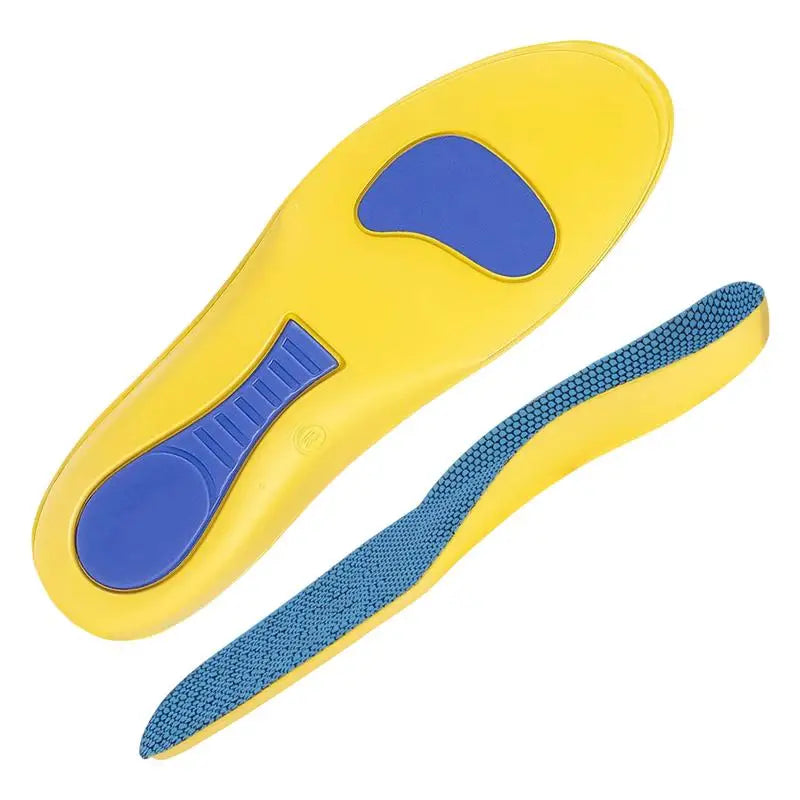
SHIFT's deep U-shaped heel cup has raised side walls that hold the pad in place, so it can keep doing the cushioning job it was built to do.
What the research actually shows
-
Containing the pad measurably helps
In a 2022 study using ultrasound elastography, a plastic heel cup increased the thickness of the heel's cushioning layer to about 137% and cut the internal stiffness of that layer to about 55% of the level without a cup. (Lin et al., Journal of Clinical Medicine, 2022)
-
Confinement adds shock absorption
Lab drop-testing found that confining the heel pad increased its shock absorbency by roughly 30% in healthy pads and about 49% in worn ones. (Jørgensen & Bojsen-Møller, Foot & Ankle, 1989)
-
Off-the-shelf can match custom
A 2018 review of 20 trials, summarized by Harvard Health, found no difference in short-term relief between expensive custom orthotics and store-bought supports. (British Journal of Sports Medicine, 2018)
SHIFT Insoles
Between sizes? Choose the larger one — they trim to fit.
Free shipping. 60-day promise — if they're not for you, keep them and we'll refund you. Delivered from our US warehouse in 10 to 20 business days.
View full details
A deep U-shaped heel cup
Raised side walls wrap the heel and hold its natural padding in place instead of letting it spread flat. This is the part SHIFT is built around.
Trim-to-fit for real work shoes
Guide lines on the underside let you trim the length with scissors so they sit right in clogs, slip-resistant shoes, and lace-ups. Cut small and check the fit before trimming more.
Built to last a full shift
A moisture-wicking, antimicrobial top cover for a long day, with gel underfoot at the heel and forefoot.
A firm arch shelf
Under the arch there's a firm high-density EVA shelf for steady support — not a tall bump that pokes. It's there to back up the heel cup, not to be the whole insole.
Will they fit the shoes worn to work?
Most work shoes — clogs, slip-resistant kitchen shoes, steel-toes, lace-ups — have a removable insole inside. The quick check: pull out the insole that came with the shoe. If it lifts out, SHIFT goes in its place, no crowding.
Some work shoes have the insole built in rather than removable. SHIFT can still go on top — trim it to match the shape of the shoe's footbed, and expect a little less room than in a shoe with a removable insole.
When to replace them (yes, they wear out)
Here's the part most insole sellers won't put in writing: foam wears out. Every EVA insole packs down with use. Lab testing on running foam found cushioning dropped off measurably after a few hundred kilometres of hard use.
For someone standing a full shift on hard floors most days, plan on replacing a pair roughly every 6 to 9 months — sooner if the heel area feels flatter than it did. That's normal, and it's the same for the $200 pairs.
What the first two weeks feel like
A firm support that holds the heel in place feels different at first, because the foot has been moving a certain way for a long time. Most people notice the heel cup right away.
A common pattern: the first few days feel great, then there's a break-in stretch where the arch or heel feels "worked." That's the foot adjusting, and it usually settles within a week or two.
The move that works: wear them a few hours a day for the first three or four days, then build up to a full shift. Going straight to a 12-hour day on day one is the main reason people give up too early. Ease in and give them two weeks.
Straight answers
"I've tried insoles before and they didn't work."
Fair. Most insoles are built to prop up the arch and leave the heel to spread flat. SHIFT is built the other way around — a deep heel cup first, arch support second.
"Won't they pack flat in a month?"
All foam packs down eventually. For daily standing, plan on a new pair every 6 to 9 months. That's why we tell you the replacement window up front instead of hiding it.
"$40 for insoles? Is this just a generic import?"
It's an off-the-shelf support, not a $400 custom mould — and research has found custom orthotics give no better short-term relief than store-bought. If it doesn't earn its place, keep it and we'll refund you.
"Don't I need real custom orthotics?"
Some feet need a clinician. But for general all-day-standing support, off-the-shelf can match custom for short-term relief. Start here before spending hundreds.
"Will they fit my shoes or make them tight?"
They're trim-to-fit. If your work shoe has a removable insole, SHIFT replaces it with no crowding.
"What if the arch lands in the wrong spot?"
The arch piece is a firm shelf, not a tall pointed bump, so it supports without poking one spot. The main event is the heel cup.
"How long until they feel right?"
Ease in over the first few days rather than a full shift on day one. Most people settle in within one to two weeks.
"What if they don't work for me?"
60 days. If they're not right, you keep them and we refund you — nothing to ship back.
"How long is shipping?"
Free shipping from our US warehouse. Delivery is usually 10 to 20 business days.
The 60-day promise
Try SHIFT for 60 days. If they're not right, email us and we'll refund you — no need to ship anything back. Keep them.
Free shipping on every order. We ship from a US warehouse, and delivery usually takes 10 to 20 business days. You'll get tracking by email once it's on the way.
SHIFT Insoles
Between sizes? Choose the larger one — they trim to fit.
Built for people who spend the day on their feet. Deep heel cup, trim to fit, 60-day keep-it-if-it's-wrong promise.
Share

Sizing, care & orders
How do I pick my size?
Find your usual shoe size in the Women's or Men's list and choose that option. If you're between two sizes, pick the larger one — SHIFT is trim-to-fit. Sizes run through Men's 10 and Women's 11. If you're above that, contact us before ordering.
How do I trim them?
Flip the insole over, match it against the insole you removed from your shoe, mark the extra length, and cut along the guide lines. Cut a little at a time.
How do I clean them?
Wipe with a damp cloth and mild soap, air dry fully. Don't machine wash or put them near heat.
Where do you ship from?
A US warehouse, free, usually 10 to 20 business days. You'll get tracking by email.